The raw data
Do teams that hit more home runs score more runs? x = home runs, y = runs scored — both per season, six teams.

6 MLB teams — one season
| Team | Home runs (x) | Runs scored (y) |
|---|---|---|
| Yankees | 245 | 807 |
| Dodgers | 221 | 758 |
| Red Sox | 198 | 726 |
| Astros | 214 | 749 |
| Cubs | 177 | 691 |
| Padres | 162 | 668 |
Find the means x̄ and ȳ
The means are the data's centre of gravity. A key OLS fact: the fitted line always passes through the point (x̄, ȳ).

x̄ — mean home runs
ȳ — mean runs scored
Compute Sxx and Sxy
Sxx measures how spread out the home-run counts are. Sxy measures how x and y move together. Both feed straight into the slope.

Deviation table
| Team | xᵢ−x̄ | yᵢ−ȳ | (xᵢ−x̄)² | (xᵢ−x̄)(yᵢ−ȳ) |
|---|---|---|---|---|
| Yankees | 42.17 | 73.83 | 1778.3 | 3113.7 |
| Dodgers | 18.17 | 24.83 | 330.1 | 451.2 |
| Red Sox | −4.83 | −7.17 | 23.3 | 34.6 |
| Astros | 11.17 | 15.83 | 124.8 | 176.8 |
| Cubs | −25.83 | −42.17 | 667.4 | 1089.3 |
| Padres | −40.83 | −65.17 | 1667.1 | 2661.6 |
| Σ | ≈ 0 | ≈ 0 | 4591.0 | 7527.2 |
The slope β̂₁ and intercept β̂₀
With Sxx and Sxy in hand, the line is one division and one subtraction away.

Slope
Each extra home run is worth about 1.639 more runs.
Intercept
Fitted values ŷᵢ and residuals eᵢ
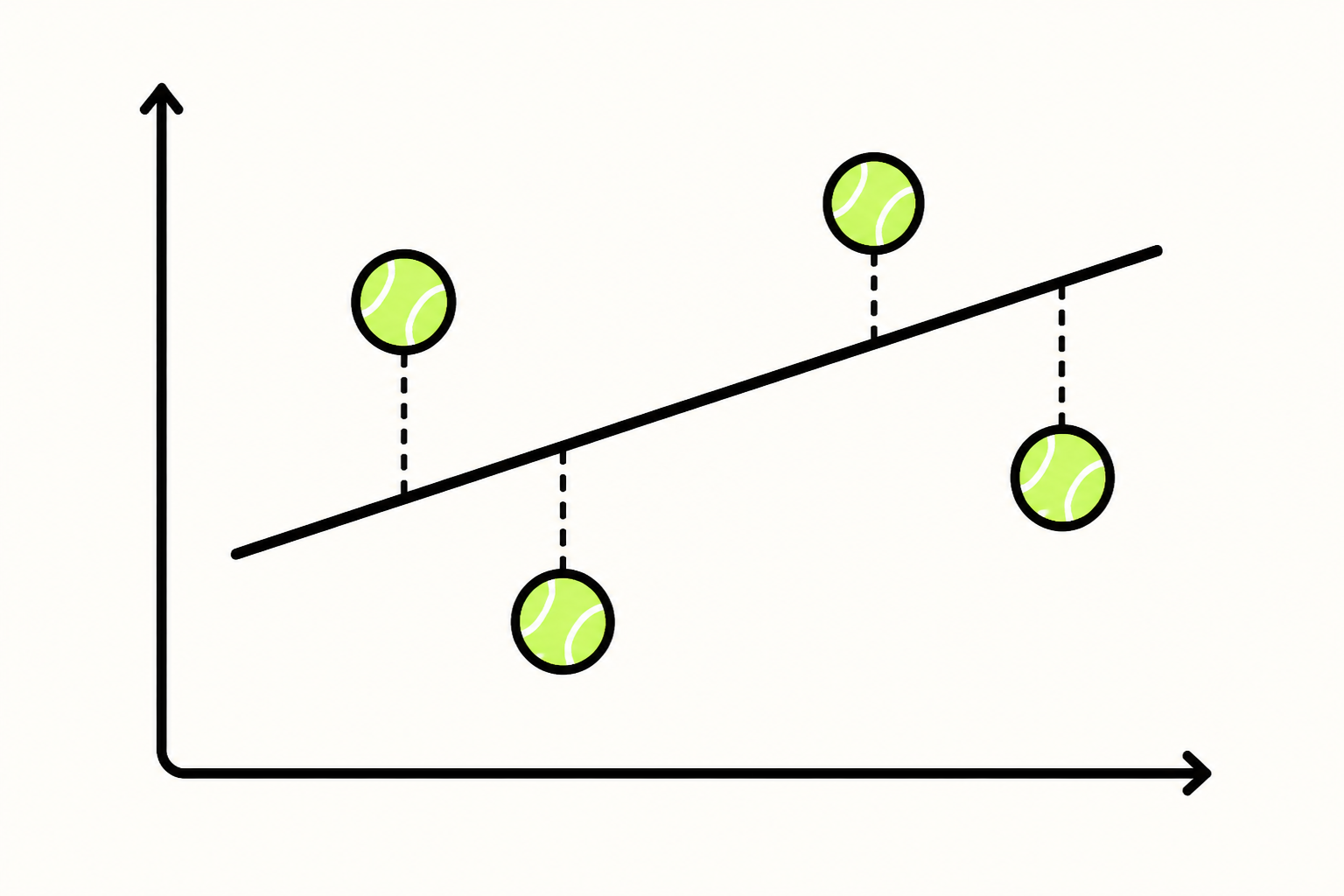
Plug each xᵢ into the line to get ŷᵢ. The residual eᵢ = yᵢ − ŷᵢ is how far off the model is for that team.
ŷᵢ = 400.73 + 1.639 × xᵢ
| Team | yᵢ | ŷᵢ | eᵢ | eᵢ² |
|---|---|---|---|---|
| Yankees | 807 | 802.3 | +4.7 | 22.1 |
| Dodgers | 758 | 763.0 | −5.0 | 25.0 |
| Red Sox | 726 | 725.2 | +0.8 | 0.64 |
| Astros | 749 | 751.5 | −2.5 | 6.25 |
| Cubs | 691 | 690.8 | +0.2 | 0.04 |
| Padres | 668 | 666.2 | +1.8 | 3.24 |
| Σ | ≈ 0 | 57.3 |
SSE and the variance estimate s²
SSE is the total squared error after fitting. s² estimates σ² — the natural scatter around the true line.

Sum of squared errors
Variance estimate
R² — how much we explained
R² answers: what proportion of the total variation in runs does the model account for?

Total sum of squares
R²
Putting it into words
Every quantity, its value, and what it actually means — plus how to phrase it in an exam.

Summary
| Quantity | Value | Meaning |
|---|---|---|
| β̂₁ | 1.639 | +1 HR → +1.639 runs |
| β̂₀ | 400.73 | Baseline runs at x = 0 |
| SSE | 57.3 | Unexplained squared error |
| s | 3.79 | Typical miss (± runs) |
| R² | 0.9954 | 99.5% of variation explained |
How to write it in an exam
Slope: For each additional home run in a season, a team is estimated to score 1.639 more runs on average.
Intercept: A team hitting zero home runs is predicted to score 400.73 runs (non-HR scoring) — but x = 0 is outside the data, so it isn't practically meaningful.
R²: Home runs explain 99.5% of the variation in runs scored — an excellent fit.